

Chancellor's Advisory Committee on History and Context
Chancellor Jeffrey Vitter established the Chancellor's Advisory Committee on History and Context in summer 2016 to address Recommendation 5 of the university’s 2014 Action Plan, a comprehensive set of recommendations related to improving the campus’ environment for diversity and inclusion. Recommendation 5 of the action plan urged the university to “offer more history, putting the past into context” and to do so “without attempts to erase history, even some difficult history.”
“Contextualization is an important extension of a university’s responsibility to educate and provides an opportunity to learn from history,” Vitter said. “As an educational institution, it is imperative we foster a learning environment and fulfill our mission by pursuing knowledge and understanding. The CACHC embodied this approach in its work, recognizing that while our history is not by any means all that we are, it remains an important part of who we are.”
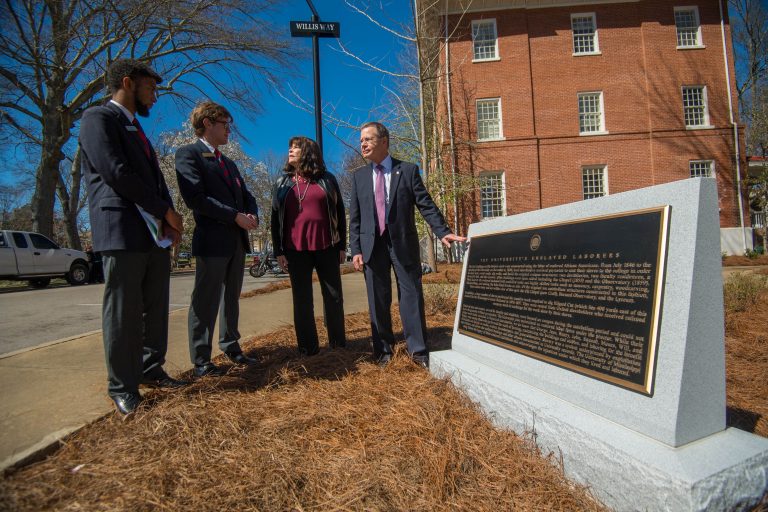
During the 2016-17 academic year, the CACHC worked to complete its two-phase charge. The initial task of the committee was to recommend which additional physical sites on the Oxford campus (beyond those already completed) should be contextualized, so as to explain the environment in which they were created or named.
Secondly, the committee was tasked with designing the content and format to contextualize the recommended sites. In the final report, the committee explained that “contextualizing the campus reminds us of the enormity and complexity of our shared past” and that “done correctly, and therefore carefully, contextualization is an additive process, not a subtractive one.”
Read the entire story by UM News, released on July 6, 2017.