

Each fall (and sometimes in the spring), CETL hosts a reading group open to all university faculty. CETL purchases books for attendees, which are available for pick-up in advance of our first meeting. We meet three times over the course of the semester to discuss the selected book.
-
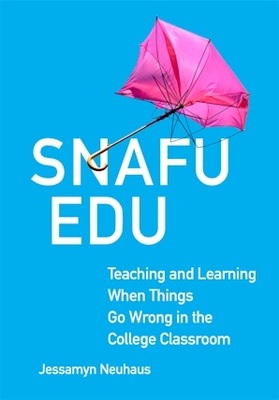
Spring 2026. Snafu Edu: Teaching and Learning When Things Go Wrong in the College Classroom
Jessamyn Neuhaus
Faculty Reading Group
- Dates: Fridays, February 13, February 27, and March 6, 2026
- Time: 2:00-3:00 pm
- Location: Zoom
- Facilitators: Emily Pitts Donahoe, Josh Eyler, and Liz Norell
This spring, the Faculty Reading Group will tackle the book Snafu Edu: Teaching and Learning When Things Go Wrong in the College Classroom, by Jessamyn Neuhaus.
No matter how skilled, thoughtful, and well prepared professors are—or how motivated and engaged their students might be—things sometimes go wrong. In this empowering, smart, and refreshingly frank book, Jessamyn Neuhaus offers college educators a roadmap for anticipating and navigating these inevitable snafus—and keeping the course of teaching and learning on track. Clear-eyed about the rarely acknowledged foul-ups that teachers invariably confront, Snafu Edu provides evidence-based insights into why these things happen and practical, workable strategies for recognizing, responding to, repairing, and reducing them.
Snafu Edu identifies five major reasons for systemic and individual snafus in the field—inequity, disconnection, distrust, failure, and fear—and shows how understanding underlying causes can help educators perceive the problem and take appropriate measures. These measures are part of a problem-solving approach that Neuhaus calls STIR: stop, think, identify, and repair. She details course design principles and pedagogical practices to reduce major teaching and learning snafus by increasing equity, building connections, fostering trust, enabling success, and increasing agency for both educators and students.
Looking beyond “classroom management” and “conflict resolution,” Snafu Edu carefully and clearly grounds its lessons in the real context of education, where institutional structures, systemic injustices, individual and collective history, and the complexity of human interactions mean there will always be snafus. Like a preparedness kit for natural disasters, the book gives teachers an educational “go-bag” of insights, strategies, and practices to have at the ready when things go sideways.
-
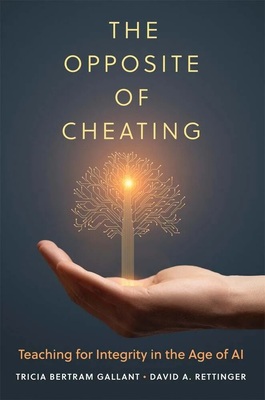
Fall 2025. The Opposite of Cheating: Teaching for Integrity in the Age of AI
Tricia Bertram Gallant and David A. Rettinger
In this book, Tricia Bertram Gallant and David A. Rettinger propose a new approach to academic integrity—one that’s in line with the realities of twenty-first century schooling. The book is deeply grounded in research on academic integrity and full of practical suggestions that can help instructors reduce cheating and enhance learning for their students. It offers "a much-needed chance to pause, rethink our purpose, and refocus on what matters—creating classes that center human interactions that foster the personal and professional growth of our students."
-
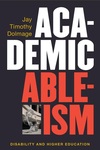
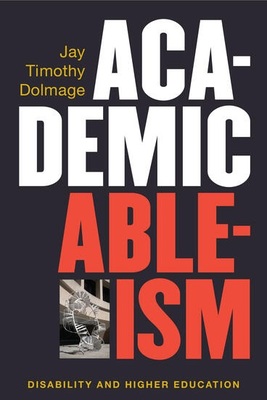
Spring 2024. Academic Ableism: Disability and Higher Education
Jay Timothy Dolmage
January 31, February 21, and March 21, 1:00-2:00 pm Liz Norell In this spring reading group, we invite UM campus members to explore the book Academic Ableism: Disability and Higher Education by Jay Dolmage, a leading scholar in disability studies. Over the course of three sessions, we’ll discuss the ideas from the book in the context of our campus. We invite faculty, staff, and students to join us. (NOTE: The book is available online as an open resource through Project Muse.) Academic Ableism brings together disability studies and institutional critique to recognize the ways that disability is composed in and by higher education, and rewrites the spaces, times, and economies of disability in higher education to place disability front and center. For too long, argues Jay Timothy Dolmage, disability has been constructed as the antithesis of higher education, often positioned as a distraction, a drain, a problem to be solved. The ethic of higher education encourages students and teachers alike to accentuate ability, valorize perfection, and stigmatize anything that hints at intellectual, mental, or physical weakness, even as we gesture toward the value of diversity and innovation. Examining everything from campus accommodation processes, to architecture, to popular films about college life, Dolmage argues that disability is central to higher education, and that building more inclusive schools allows better education for all.
-
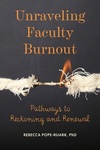
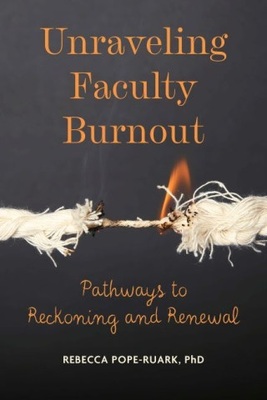
Fall 2024. Unraveling Faculty Burnout: Pathways to Reckoning and Renewal
Rebecca Pope-Ruark
Faculty often talk about how busy, overwhelmed, and stressed they are. These qualities are seen as badges of honor in a capitalist culture that values productivity above all else. But for many women in higher education, exhaustion and stress go far deeper than end-of-the-semester malaise. Burnout, a mental health syndrome caused by chronic workplace stress, is endemic to higher education in a patriarchal, productivity-obsessed culture. In this unique book for women in higher education, Rebecca Pope-Ruark, PhD, draws from her own burnout experience, as well as collected stories of faculty in various roles and career stages, interviews with coaches and educational developers, and extensive secondary research to address and mitigate burnout. Pope-Ruark lays out four pillars of burnout resilience for faculty members: purpose, compassion, connection, and balance. Each chapter contains relatable stories, reflective opportunities and exercises, and advice from women in higher education. Blending memoir, key research, and reflection opportunities, Pope-Ruark helps faculty not only address burnout personally but also use the tools in this book to eradicate the systemic conditions that cause it in the first place. As burnout becomes more visible, we can destigmatize it by acknowledging that women are not unraveling; instead, women in higher education are reckoning with the productivity cult embedded in our institutions, recognizing how it shapes their understanding and approach to faculty work, and learning how they can remedy it for themselves, their peers, and women faculty in the future.
-
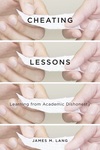
Fall 2023. Cheating Lessons: Learning from Academic Dishonesty
James M. Lang
Nearly three-quarters of college students cheat during their undergraduate careers, a startling number attributed variously to the laziness of today’s students, their lack of a moral compass, or the demands of a hypercompetitive society. For James Lang, cultural or sociological explanations like these are red herrings. His provocative new research indicates that students often cheat because their learning environments give them ample incentives to try—and that strategies which make cheating less worthwhile also improve student learning. Cheating Lessons is a practical guide to tackling academic dishonesty at its roots. Drawing on an array of findings from cognitive theory, Lang analyzes the specific, often hidden features of course design and daily classroom practice that create opportunities for cheating. Courses that set the stakes of performance very high, that rely on single assessment mechanisms like multiple-choice tests, that have arbitrary grading criteria: these are the kinds of conditions that breed cheating. Lang seeks to empower teachers to create more effective learning environments that foster intrinsic motivation, promote mastery, and instill the sense of self-efficacy that students need for deep learning. Although cheating is a persistent problem, the prognosis is not dire. The good news is that strategies which reduce cheating also improve student performance overall. Instructors who learn to curb academic dishonesty will have done more than solve a course management problem—they will have become better educators all around.
-
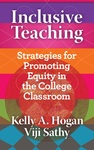
Fall 2022. Inclusive Teaching: Strategies for Promoting Equity in the College Classroom
Kelly A. Hogan and Viji Sathy
In a book written by and for college teachers, Kelly Hogan and Viji Sathy provide tips and advice on how to make all students feel welcome and included. They begin with a framework describing why explicit attention to structure enhances inclusiveness in both course design and interactions with and between students. Inclusive Teaching then provides practical ways to include more voices in a series of contexts: when giving instructions for group work and class activities, holding office hours, communicating with students, and more. The authors finish with an opportunity for the reader to reflect on what evidence to include in a teaching dossier that demonstrates inclusive practices. The work of two highly regarded specialists who have delivered over a hundred workshops on inclusive pedagogy and who contribute frequently to public conversations on the topic, Inclusive Teaching distills state-of-the-art guidance on addressing privilege and implicit bias in the college classroom. It seeks to provide a framework for individuals and communities to ask, Who is being left behind and what can teachers do to add more structure?