

Digital Scholarship Showcase


-
Demarginalizing Bede’s Margins
Nicholas Sumrall
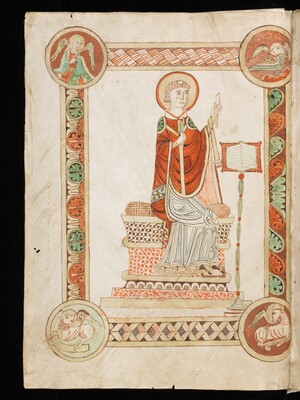
Description: Nicholas Sumrall will present the findings of his M.A. thesis project, which was a paleographic study of an Old English manuscript that has recently been uploaded to an open-access digital database, the Parker Library on the Web. The manuscript is one of five surviving Old English translations of Bede's Ecclesiastical History of the English People; in addition to this primary text, the manuscript also contains an eclectic assortment of charms, poetry, prayers, and homilies throughout its margins in a manner unparalleled in any other Old English manuscript. Nicholas's research focused on assessing the physical and thematic relationships between the manuscript's body text and its extensive marginalia, which past scholars have deemed "unrelated" to each other. In doing so, his study not only calls into question centuries-old academic theories of the manuscript's function, but also reveals new perspectives on Anglo-Saxon literary culture and religious practices.
About the presenter: Nicholas is a third-year M.A. student in the Department of English studying Old English literature and paleography. He also obtained his B.A. in Classics with a minor in Medieval Studies here at the University of Mississippi in 2021. -

Curating Juano Hernandez's Radio Career with AI Technologies
Nick Sabo
Nick's project archives and contextualizes the radio career of Juano Hernandez, a prolific Black actor in the 1930s and 40s. Nick uses modern algorithms useful for the archival of audio media and discusses the historical entwining of data science into the folk genre and primitivized depictions of marginalized groups. He examines implicit biases and potential ways of contextualizing those stories in the present day.
-
Mapping Made Easy
Adam Clemons
In this workshop, participants will learn how to create simple maps using three web-based mapping tools: Social Explorer, Tableau, and ArcGIS Online. The session will begin with a brief introduction to important mapping terminology including GIS and geospatial data. The remainder of the session will focus on the three mapping tools listed above starting with an overview of key features and culminating with a live demonstration of how to make maps with each tool.
- Social Explorer is a web-based tool for accessing and visualizing data on a range of topics with over five-hundred thousand data indicators related to demographics, economy, health, education, politics, crime, environment, etc. at many geographic levels including national, state, county, ZIP, neighborhood, etc.
- Tableau is an interactive, highly accessible data visualization tool for analyzing raw data. It works with a number of geospatial file types including shapefiles, KML files, and GeoJSON files. It also offers a range of map options including symbol maps, choropleth and isopleth maps, point distribution maps, flow maps, and many more.
- ArcGIS Online is a cloud-based mapping and analysis tool. It supports a wide range of geospatial files and map types including three dimensional maps. It is primarily used for building maps, analyzing data, sharing content, and collaborating with others. More advanced options include 3D web scenes, web apps, and setting up notebooks for creating, sharing, and running data science scripts.
-
Mapping Memphis
Abbie Norris-Davidson
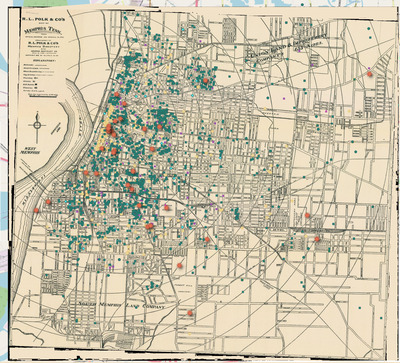
“Mapping Memphis” is a spatial humanities project that analyses how historic geographic data can offer new insights into urban heritage and community. It does so using a primary source largely underrepresented in digital humanities research: funeral home ledgers. From 1904-1929, T. H. Hayes and Sons Funeral Home, the oldest African American owned business in Memphis, Tennessee recorded demographic and funereal information for over 4,000 African American individuals. This project focuses on the physical locations recorded in each entry that inadvertently offer a glimpse into the decedents’ homes, offices, and community spaces in early 20th century Memphis. It plots these individual locations onto a digital map, creating a visual representation of Black Memphis’ social and physical layout a century ago and exploring the depths of information that can be pulled from this unique resource.
-

Penny University Library
Christian Murray
Back in the 17th and 18th centuries, the gentry of England gathered in coffee houses to discuss a wide array of issues. These places were known as Penny Universities because, for the price of a penny, one could purchase a cup of coffee and enjoy an intellectual conversation! Penny University Library is a free to use multimedia project that offers a digitized collection of authors, publications, and maps from the Age of Enlightenment. This tool is great for public education, classrooms, and scholarly use for understanding key details about the intellectual conversations of the past.
To view a short video clip introducing the project, please click here: https://youtu.be/SD3oVheVj1A?si=05N04wyhWk6ku2lN
Free and open to the public. All are welcome. Participates will have time at the end of the presentation to ask questions and share thoughts and suggestions.