• Home
  • Search
  • Browse Collections
  • My Account
  • About
  • DC Network Digital Commons Network™
Skip to main content
eGrove University of Mississippi
  • Home
  • About
  • FAQ
  • My Account

Home > Library > Digital Collections > Archival Digital Accounting Collection > Deloitte Collection > Proceedings from Kansas Symposium

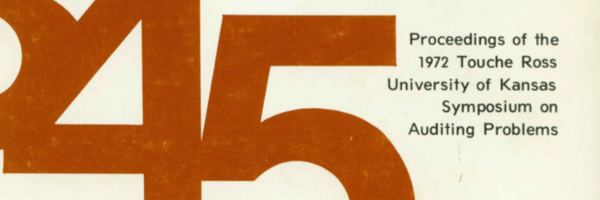
Proceedings of the University of Kansas Symposium on Auditing Problems
 

Proceedings of the University of Kansas Symposium on Auditing Problems

The Deloitte/University of Kansas Auditing Symposium has been held on a bi-annual basis since 1972. Its purpose is to provide a forum where practitioners, regulators, and academics can come together and have open discussions about the auditing profession from each of their unique perspectives. It is seen as a greatly beneficial event for practitioners, regulators, and academics alike. Information about current symposia can be found at the University of Kansas School of Business.

Printing is not supported at the primary Gallery Thumbnail page. Please first navigate to a specific Image before printing.

Follow

Switch View to Grid View Slideshow
 
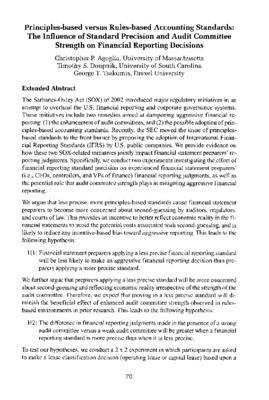
  • Principles-based versus Rules-based Accounting Standards: The Influence of Standard Precision and Audit Committee Strength on Financial Reporting Decisions by Christopher P. Agoglia, Timothy S. Doupnik, and George T. Tsakumis

    Principles-based versus Rules-based Accounting Standards: The Influence of Standard Precision and Audit Committee Strength on Financial Reporting Decisions

    Christopher P. Agoglia, Timothy S. Doupnik, and George T. Tsakumis

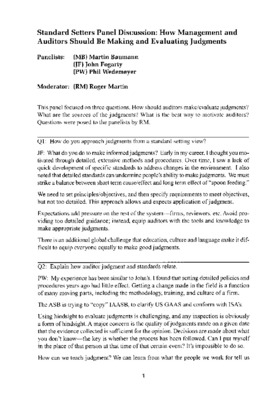
  • Standard Setters Panel Discussion: How Management and Auditors Should Be Making and Evaluating Judgments by Martin Baumann, John Fogarty, Phil Wedemeyer, and Roger Martin

    Standard Setters Panel Discussion: How Management and Auditors Should Be Making and Evaluating Judgments

    Martin Baumann, John Fogarty, Phil Wedemeyer, and Roger Martin

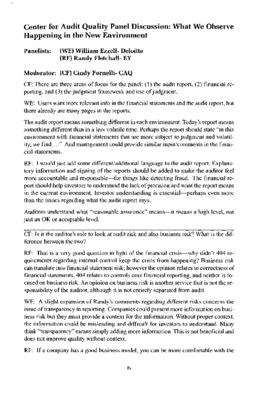
  • Center for Audit Quality Panel Discussion: What We Observe Happening in the New Environment by William Ezzell, Randy Fletchall, and Cindy Fornelli

    Center for Audit Quality Panel Discussion: What We Observe Happening in the New Environment

    William Ezzell, Randy Fletchall, and Cindy Fornelli

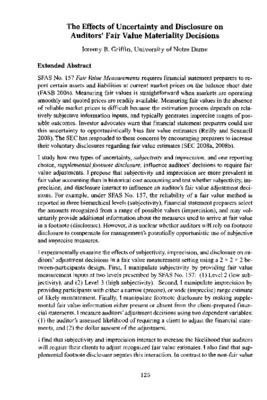
  • Effects of Uncertainty and Disclosure on Auditors’ Fair Value Materiality Decisions by Jeremy .B. Griffin

    Effects of Uncertainty and Disclosure on Auditors’ Fair Value Materiality Decisions

    Jeremy .B. Griffin

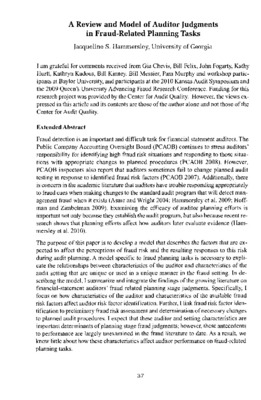
  • Review and Model of Auditor Judgments in Fraud-Related Planning Tasks by Jacqueline Hammersley

    Review and Model of Auditor Judgments in Fraud-Related Planning Tasks

    Jacqueline Hammersley

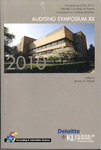
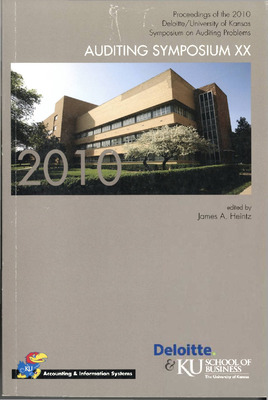
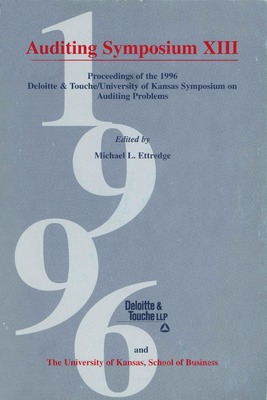
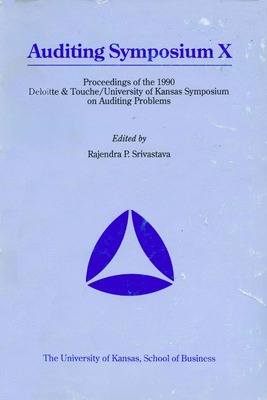
  • Auditing Symposium XX, Proceedings of the 2010 Deloitte/University of Kansas Symposium on Auditing Problems by James A. Heintz

    Auditing Symposium XX, Proceedings of the 2010 Deloitte/University of Kansas Symposium on Auditing Problems

    James A. Heintz

  • When Is Trusted Advice Not Trustworthy? How Affiliation and Advice Quality Influence Auditors’ Evaluation and Use of Advice by Kathryn Kadous, Justin Leiby, and Mark E. Peecher

    When Is Trusted Advice Not Trustworthy? How Affiliation and Advice Quality Influence Auditors’ Evaluation and Use of Advice

    Kathryn Kadous, Justin Leiby, and Mark E. Peecher

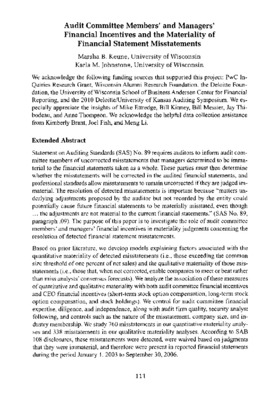
  • Audit Committee Members’ and Managers’ Financial Incentives and the Materiality of Financial Statement Misstatements by Marsha B. Keune and Karla M. Johnstone

    Audit Committee Members’ and Managers’ Financial Incentives and the Materiality of Financial Statement Misstatements

    Marsha B. Keune and Karla M. Johnstone

  • Importance of Auditor Judgment in Improving Audit Quality by W. Robert Knechel

    Importance of Auditor Judgment in Improving Audit Quality

    W. Robert Knechel

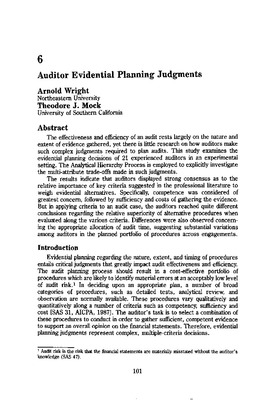
  • Impact of Principles-Versus Rules-Based Accounting Standards on Auditors’ Motivations and Judgments by Marietta Peytcheva and Arnold M. Wright

    Impact of Principles-Versus Rules-Based Accounting Standards on Auditors’ Motivations and Judgments

    Marietta Peytcheva and Arnold M. Wright

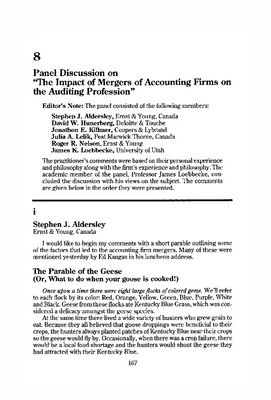
  • Audit Partners Panel Discussion: How Are We Dealing with the Increased Level of Judgment? by Hal Zeidman, Brian Richson, Leroy Dennis, and Bill Messier

    Audit Partners Panel Discussion: How Are We Dealing with the Increased Level of Judgment?

    Hal Zeidman, Brian Richson, Leroy Dennis, and Bill Messier

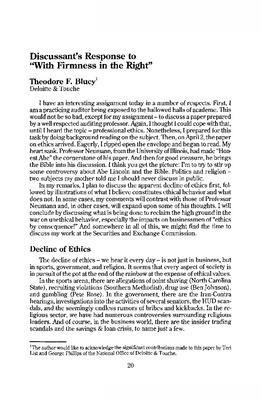
  • Deductive Method of Fraud Detection; Discussant Comments for The Deductive Method of Fraud Detection by Conan C. Albrecht, W. Steve Albrecht, and J. Gregory Dunn1

    Deductive Method of Fraud Detection; Discussant Comments for The Deductive Method of Fraud Detection

    Conan C. Albrecht, W. Steve Albrecht, and J. Gregory Dunn1

  • Impact of Fraud Risk Assessments and a Standard Audit Program on the Planning of Fraud Detection Plans (Abstract); Discussant Comments on “The Impact of Fraud Risk Assessments and a Standard Audit Program on Fraud Detection Plans” by Stephen K. Asare, Arnie Wright, and Karla M. Johnstone

    Impact of Fraud Risk Assessments and a Standard Audit Program on the Planning of Fraud Detection Plans (Abstract); Discussant Comments on “The Impact of Fraud Risk Assessments and a Standard Audit Program on Fraud Detection Plans”

    Stephen K. Asare, Arnie Wright, and Karla M. Johnstone

  • Auditor Industry Specialization and Fraudulent Financial Reporting; Discussant’s Response: “Auditor Industry Specialization and Fraudulent Financial Reporting” by Joseph V. Carcello, Albert L. Nagy, and Audrey A. Gramling

    Auditor Industry Specialization and Fraudulent Financial Reporting; Discussant’s Response: “Auditor Industry Specialization and Fraudulent Financial Reporting”

    Joseph V. Carcello, Albert L. Nagy, and Audrey A. Gramling

  • Financial Statement Fraud - Today’s Challenge by John Fogarty

    Financial Statement Fraud - Today’s Challenge

    John Fogarty

  • Proceedings of the 2002 Auditing Symposium XVI: Deloitte & Touche/University of Kansas Symposium on Auditing Problems by James A. Heintz, University of Kansas. School of Business, and Deloitte & Touche

    Proceedings of the 2002 Auditing Symposium XVI: Deloitte & Touche/University of Kansas Symposium on Auditing Problems

    James A. Heintz, University of Kansas. School of Business, and Deloitte & Touche

  • Detecting Financial Statement Fraud: Proposed SAS 82 Revision by Dacid L. Landsittel

    Detecting Financial Statement Fraud: Proposed SAS 82 Revision

    Dacid L. Landsittel

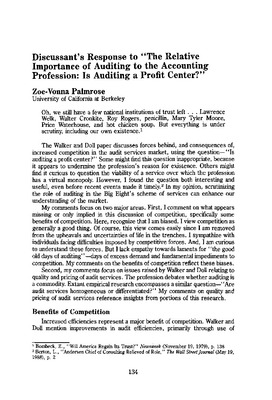
  • Fraudulent Financial Reporting: Some Evidence from Restatements; Discussant Comments for Fraudulent Financial Reporting: Some Evidence from Restatements by Zoe-Vonna Palmrose, Susan Scholz, and Timothy Bell

    Fraudulent Financial Reporting: Some Evidence from Restatements; Discussant Comments for Fraudulent Financial Reporting: Some Evidence from Restatements

    Zoe-Vonna Palmrose, Susan Scholz, and Timothy Bell

  • Conceptual Framework and Case Studies for Audit Planning and Evaluation Given the Potential for Fraud; Discussant Comments on A Conceptual Framework and Case Studies for Audit Planning and Evaluation Given the Potential for Fraud by Jerry L. Turner, Theodore J. Mock, Rajendra P. Srivastava, and Ray Whittington

    Conceptual Framework and Case Studies for Audit Planning and Evaluation Given the Potential for Fraud; Discussant Comments on A Conceptual Framework and Case Studies for Audit Planning and Evaluation Given the Potential for Fraud

    Jerry L. Turner, Theodore J. Mock, Rajendra P. Srivastava, and Ray Whittington

  • Audit Policy Implications of Academic Research on Fraudulent Financial Reporting; Comments on Academic Research and Auditors’ Detection of Fraudulent Financial Reporting: Audit Policy Implications by T. Jeffrey Wilks, Mark F. Zimbelman, Selvoy J. Boyer, and William F. Messier Jr.

    Audit Policy Implications of Academic Research on Fraudulent Financial Reporting; Comments on Academic Research and Auditors’ Detection of Fraudulent Financial Reporting: Audit Policy Implications

    T. Jeffrey Wilks, Mark F. Zimbelman, Selvoy J. Boyer, and William F. Messier Jr.

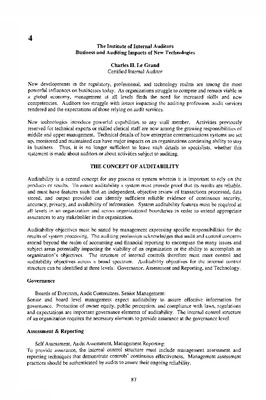
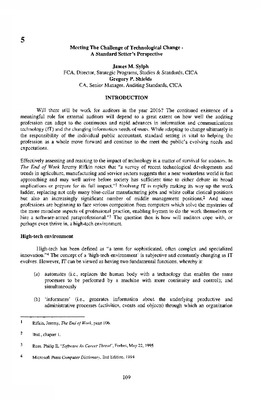
  • Technological change -- A glass half empty or a glass half full: Discussion of "Meeting the challenge of technological change," and "Business and auditing impacts of new technologies" by Urton Anderson

    Technological change -- A glass half empty or a glass half full: Discussion of "Meeting the challenge of technological change," and "Business and auditing impacts of new technologies"

    Urton Anderson

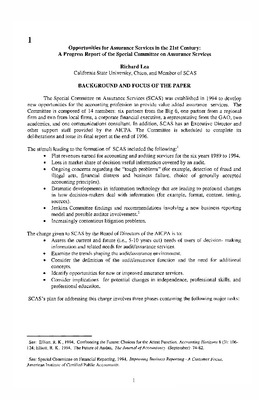
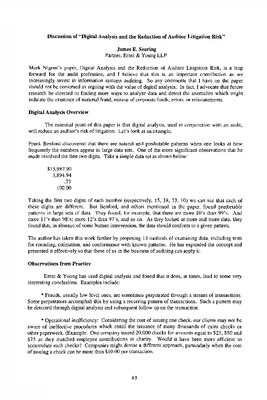
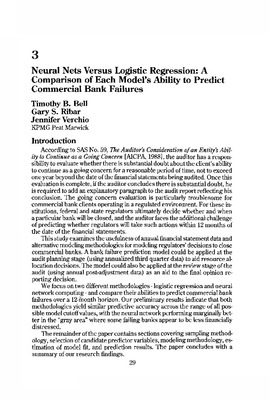
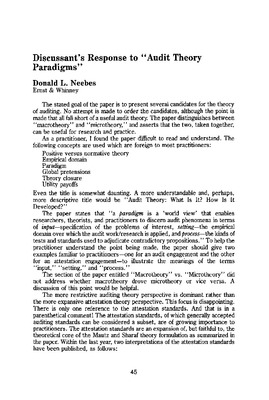
  • Discussion of "A Model of errors and irregularities as a general framework for risk-based audit planning" by Timothy B. Bell

    Discussion of "A Model of errors and irregularities as a general framework for risk-based audit planning"

    Timothy B. Bell

  • Discussant comments on "The CPAS/CCM experiences: Perspectives for AI/ES research in accounting" by Eric Denna

    Discussant comments on "The CPAS/CCM experiences: Perspectives for AI/ES research in accounting"

    Eric Denna

  • Model of errors and irregularities as a general framework for risk-based audit planning by Jere R. Francis and Richard A. Grimlund

    Model of errors and irregularities as a general framework for risk-based audit planning

    Jere R. Francis and Richard A. Grimlund

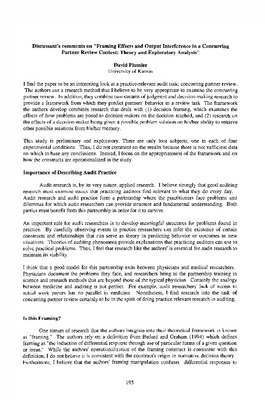
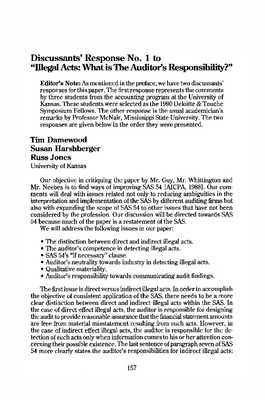
  • Framing effects and output interference in a concurring partner review context: Theory and exploratory analysis by Karla M. Johnstone, Stanley F. Biggs, and Jean C. Bedard

    Framing effects and output interference in a concurring partner review context: Theory and exploratory analysis

    Karla M. Johnstone, Stanley F. Biggs, and Jean C. Bedard
 

Page 1 of 10

  • 1
  • 2
  • 3
  • 4
  • 5
  • 6
  • 7


Browse

  • Collections
  • Disciplines
  • Authors

Search

Advanced Search

  • Notify me via email or RSS

Author Corner

  • Author FAQ

Additional Information

  • Request an Accessible Copy
 
Elsevier - Digital Commons

Home | About | FAQ | My Account | Accessibility Statement

Privacy Copyright